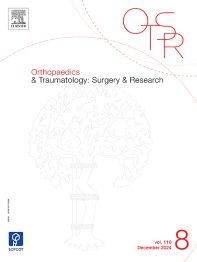
Since 2009, Orthopaedics & Traumatology: Surgery & Research (OTSR) is the e-only English version of the Revue de chirurgie orthopédique et traumatologique in order to play a major role in the essential mission of Medical Publishing: sharing, generating and disseminating knowledge.
All articles accepted for publication in the print journal are translated into English; it allows French speaking authors to see their research benefit from a larger international audience.
A true aide in continuing medical education
Orthopaedics & Traumatology: Surgery & Research is an excellent aid for continuing medical education; its highly varied topics will contribute significantly to optimizing your methods: original articles on clinical or basic science research topics relevant to orthopaedics, technical notes presenting innovations in the use of exploration or evaluation materials, review articles, and letters to the editor from readers about articles already published.
A federating journal in the domain, Orthopaedics & Traumatology: Surgery & Research has an editorial board of specialists from France and around the world with an international reputation that allows it to publish the best articles in the speciality.
Now 118 years old, the Revue de chirurgie orthopédique et traumatologique, dedicated to orthopaedic surgeons and researchers, is the leading publication to the French speaking audience in its field.
Seuls les utilisateurs munis d'un compte client peuvent laisser un commentaire. Veuillez vous connecter ou créer un compte s'il vous plait.
product
https://www.elsevier-masson.fr/orthopaedics-traumatology-surgery-research-1877-0568.html310936Orthopaedics & Traumatology: Surgery & Researchhttps://www.elsevier-masson.fr/media/catalog/product/1/8/18770568_8.jpg127127EURInStock/Médecine/Chirurgie orthopédique/Médecine/Chirurgie orthopédique/Traumatologie/Revues2909159344302852612820428371Previously Revue de Chirurgie orthopédique <p>Since 2009, <i>Orthopaedics & Traumatology: Surgery & Research</i> (OTSR) is the e-only English version of the <i>Revue de chirurgie orthopédique et traumatologique</i> in order to play a major role in the essential mission of Medical Publishing: sharing, generating and disseminating knowledge.</p><p>All articles accepted for publication in the print journal are translated into English; it allows French speaking authors to see their research benefit from a larger international audience.</p><p><strong>A true aide in continuing medical education</strong></p><p><i><strong>Orthopaedics & Traumatology: Surgery & Research </strong></i>is an excellent aid for continuing medical education; its highly varied topics will contribute significantly to optimizing your methods: original articles on clinical or basic science research topics relevant to orthopaedics, technical notes presenting innovations in the use of exploration or evaluation materials, review articles, and letters to the editor from readers about articles already published.</p><p>A federating journal in the domain, <strong>Orthopaedics & Traumatology: Surgery & Research </strong>has an editorial board of specialists from France and around the world with an international reputation that allows it to publish the best articles in the speciality.</p><p><strong>Impact Factor: 2.3 (2023) </strong><br /><strong> 2024 Journal Citation Reports®, Clarivate Analytics</strong></p><p>Now 118 years old, the <i><strong>Revue de chirurgie orthopédique et traumatologique</strong></i>, dedicated to orthopaedic surgeons and researchers, is the leading publication to the French speaking audience in its field.</p>00149554Orthopaedics & Traumatology: Surgery & Research144.9207https://www.elsevier-masson.fr/media/catalog/product/https://www.elsevier-masson.fr/media/catalog/product/placeholder/default/generic_item_image_123x160_1_1.pngInStockRevue - NumériqueParticulierFrance (+ DOM-TOM)12 mois149563Orthopaedics & Traumatology: Surgery & Research289.8414https://www.elsevier-masson.fr/media/catalog/product/https://www.elsevier-masson.fr/media/catalog/product/placeholder/default/generic_item_image_123x160_1_1.pngInStockRevue - NumériqueParticulierFrance (+ DOM-TOM)24 mois149572Orthopaedics & Traumatology: Surgery & Research434.7621https://www.elsevier-masson.fr/media/catalog/product/https://www.elsevier-masson.fr/media/catalog/product/placeholder/default/generic_item_image_123x160_1_1.pngInStockRevue - NumériqueParticulierFrance (+ DOM-TOM)36 mois149556Orthopaedics & Traumatology: Surgery & Research181.3259https://www.elsevier-masson.fr/media/catalog/product/https://www.elsevier-masson.fr/media/catalog/product/placeholder/default/generic_item_image_123x160_1_1.pngInStockRevue - NumériqueParticulierReste du monde12 mois149565Orthopaedics & Traumatology: Surgery & Research362.6518https://www.elsevier-masson.fr/media/catalog/product/https://www.elsevier-masson.fr/media/catalog/product/placeholder/default/generic_item_image_123x160_1_1.pngInStockRevue - NumériqueParticulierReste du monde24 mois149574Orthopaedics & Traumatology: Surgery & Research543.9777https://www.elsevier-masson.fr/media/catalog/product/https://www.elsevier-masson.fr/media/catalog/product/placeholder/default/generic_item_image_123x160_1_1.pngInStockRevue - NumériqueParticulierReste du monde36 mois149555Orthopaedics & Traumatology: Surgery & Research169.39241.98https://www.elsevier-masson.fr/media/catalog/product/https://www.elsevier-masson.fr/media/catalog/product/placeholder/default/generic_item_image_123x160_1_1.pngInStockRevue - NumériqueParticulierUE (+ Suisse)12 mois149564Orthopaedics & Traumatology: Surgery & Research338.77483.96https://www.elsevier-masson.fr/media/catalog/product/https://www.elsevier-masson.fr/media/catalog/product/placeholder/default/generic_item_image_123x160_1_1.pngInStockRevue - NumériqueParticulierUE (+ Suisse)24 mois149573Orthopaedics & Traumatology: Surgery & Research508.16725.94https://www.elsevier-masson.fr/media/catalog/product/https://www.elsevier-masson.fr/media/catalog/product/placeholder/default/generic_item_image_123x160_1_1.pngInStockRevue - NumériqueParticulierUE (+ Suisse)36 mois149557Orthopaedics & Traumatology: Surgery & Research127127https://www.elsevier-masson.fr/media/catalog/product/https://www.elsevier-masson.fr/media/catalog/product/placeholder/default/generic_item_image_123x160_1_1.pngInStockRevue - NumériqueÉtudiantFrance (+ DOM-TOM)12 mois149566Orthopaedics & Traumatology: Surgery & Research254254https://www.elsevier-masson.fr/media/catalog/product/https://www.elsevier-masson.fr/media/catalog/product/placeholder/default/generic_item_image_123x160_1_1.pngInStockRevue - NumériqueÉtudiantFrance (+ DOM-TOM)24 mois149575Orthopaedics & Traumatology: Surgery & Research381381https://www.elsevier-masson.fr/media/catalog/product/https://www.elsevier-masson.fr/media/catalog/product/placeholder/default/generic_item_image_123x160_1_1.pngInStockRevue - NumériqueÉtudiantFrance (+ DOM-TOM)36 mois149559Orthopaedics & Traumatology: Surgery & Research161161https://www.elsevier-masson.fr/media/catalog/product/https://www.elsevier-masson.fr/media/catalog/product/placeholder/default/generic_item_image_123x160_1_1.pngInStockRevue - NumériqueÉtudiantReste du monde12 mois149568Orthopaedics & Traumatology: Surgery & Research322322https://www.elsevier-masson.fr/media/catalog/product/https://www.elsevier-masson.fr/media/catalog/product/placeholder/default/generic_item_image_123x160_1_1.pngInStockRevue - NumériqueÉtudiantReste du monde24 mois149577Orthopaedics & Traumatology: Surgery & Research483483https://www.elsevier-masson.fr/media/catalog/product/https://www.elsevier-masson.fr/media/catalog/product/placeholder/default/generic_item_image_123x160_1_1.pngInStockRevue - NumériqueÉtudiantReste du monde36 mois149558Orthopaedics & Traumatology: Surgery & Research147.02147.02https://www.elsevier-masson.fr/media/catalog/product/https://www.elsevier-masson.fr/media/catalog/product/placeholder/default/generic_item_image_123x160_1_1.pngInStockRevue - NumériqueÉtudiantUE (+ Suisse)12 mois149567Orthopaedics & Traumatology: Surgery & Research294.04294.04https://www.elsevier-masson.fr/media/catalog/product/https://www.elsevier-masson.fr/media/catalog/product/placeholder/default/generic_item_image_123x160_1_1.pngInStockRevue - NumériqueÉtudiantUE (+ Suisse)24 mois149576Orthopaedics & Traumatology: Surgery & Research441.06441.06https://www.elsevier-masson.fr/media/catalog/product/https://www.elsevier-masson.fr/media/catalog/product/placeholder/default/generic_item_image_123x160_1_1.pngInStockRevue - NumériqueÉtudiantUE (+ Suisse)36 mois149560Orthopaedics & Traumatology: Surgery & Research14321432https://www.elsevier-masson.fr/media/catalog/product/https://www.elsevier-masson.fr/media/catalog/product/placeholder/default/generic_item_image_123x160_1_1.pngInStockRevue - NumériqueInstitutionFrance (+ DOM-TOM)12 mois149569Orthopaedics & Traumatology: Surgery & Research28642864https://www.elsevier-masson.fr/media/catalog/product/https://www.elsevier-masson.fr/media/catalog/product/placeholder/default/generic_item_image_123x160_1_1.pngInStockRevue - NumériqueInstitutionFrance (+ DOM-TOM)24 mois149578Orthopaedics & Traumatology: Surgery & Research42964296https://www.elsevier-masson.fr/media/catalog/product/https://www.elsevier-masson.fr/media/catalog/product/placeholder/default/generic_item_image_123x160_1_1.pngInStockRevue - NumériqueInstitutionFrance (+ DOM-TOM)36 mois149562Orthopaedics & Traumatology: Surgery & Research15171517https://www.elsevier-masson.fr/media/catalog/product/https://www.elsevier-masson.fr/media/catalog/product/placeholder/default/generic_item_image_123x160_1_1.pngInStockRevue - NumériqueInstitutionReste du monde12 mois149571Orthopaedics & Traumatology: Surgery & Research30343034https://www.elsevier-masson.fr/media/catalog/product/https://www.elsevier-masson.fr/media/catalog/product/placeholder/default/generic_item_image_123x160_1_1.pngInStockRevue - NumériqueInstitutionReste du monde24 mois149580Orthopaedics & Traumatology: Surgery & Research45514551https://www.elsevier-masson.fr/media/catalog/product/https://www.elsevier-masson.fr/media/catalog/product/placeholder/default/generic_item_image_123x160_1_1.pngInStockRevue - NumériqueInstitutionReste du monde36 mois149561Orthopaedics & Traumatology: Surgery & Research1548.861548.86https://www.elsevier-masson.fr/media/catalog/product/https://www.elsevier-masson.fr/media/catalog/product/placeholder/default/generic_item_image_123x160_1_1.pngInStockRevue - NumériqueInstitutionUE (+ Suisse)12 mois149570Orthopaedics & Traumatology: Surgery & Research3097.723097.72https://www.elsevier-masson.fr/media/catalog/product/https://www.elsevier-masson.fr/media/catalog/product/placeholder/default/generic_item_image_123x160_1_1.pngInStockRevue - NumériqueInstitutionUE (+ Suisse)24 mois149579Orthopaedics & Traumatology: Surgery & Research4646.584646.58https://www.elsevier-masson.fr/media/catalog/product/https://www.elsevier-masson.fr/media/catalog/product/placeholder/default/generic_item_image_123x160_1_1.pngInStockRevue - NumériqueInstitutionUE (+ Suisse)36 mois2011 and earlier1RevueElsevier Masson1 janv. 2009EN STOCK1877-0568Bi-trimestrielRevueAnglaisRevue - Numériquehttp://www.em-consulte.com/produit/otsrRevue - Numérique<ul><li>Bi-trimestriel</li><li>Début de l'abonnement : à compter du 1<sup>er</sup> numéro de l'année civile</li></ul>NonNonNonNonVeuillez sélectionnerVeuillez sélectionnerVeuillez sélectionner